|
Frank Olito, March 26, 2021 In 2016, Carley Jackson was living in Louisiana when a natural disaster flooded half the state. With her apartment destroyed, she was forced to move into a hotel for a month. At that moment, Jackson decided to fast-track her dream of living in a tiny house, something she had been fantasizing about for a decade. She moved to Austin — a more tiny-house-friendly city — in 2019, and while there, she saved as much money as she could for her future home. But, in 2021, Jackson learned her tiny-house dreams may not become a reality. Based on past tiny-house costs she'd found in her research, Jackson saved $50,000 and thought she had enough to finally start building her home. She worked with a consultant to design a basic 26-foot tiny house with a downstairs bedroom, lots of storage, and a dishwasher for herself, her boyfriend, and their dog. When they began pricing builders, Jackson was surprised to learn their tiny house would actually cost $70,000 to $80,000. Jackson was about $30,000 short. "It was shocking," Jackson said. "You plan something and you have a dream in your head, and then it all falls apart. It's extremely frustrating." Jackson isn't alone. Potential tiny-house owners across the country are frustrated with the growing cost of tiny houses and are being forced to give up their dreams of joining the movement. The prices of tiny houses today are vastly different than they were a decade ago When the modern tiny-house movement started in the early 2000s, it was advertised as an affordable way to own a home. Shows like "Tiny House Nation," which premiered in 2014, perpetuated the idea that people could buy a tiny house for cheap, but as the movement took off, those cheaper homes became less of a reality. "In the very beginning, I don't think anyone knew exactly how much the homes we were building on 'Tiny House Nation' cost," Zack Giffin, host of the series, told Insider. "The homeowners would have a set budget and we would deliver a home regardless. The product integrations and the labor from myself and my crew were never even calculated." The median cost of a tiny house today is around $60,000, and the price keeps climbing as the demand for these smaller structures increases and builders push the boundaries of what a tiny house can look like. David Latimer of New Frontier Design, for example, created the Escher, a family-friendly tiny house that starts at $180,000. It includes a chef's kitchen, two bedrooms, a modern bathroom, and a walk-in closet. Although the Escher house is far from where the movement started, some say this is where the movement is heading. However, the price for tiny houses without high-end amenities — like Jackson's proposed design — is also increasing across the board. Lindsay Wood, who runs a tiny-house consulting business and who worked with Jackson in designing her house, said she has seen prices increase drastically even in the past year. Wood said one to two years ago, you only needed $50,000 to purchase a common 8-by-24-foot tiny house. In 2021, you need $65,000 to $75,000. Prices of materials have also gone up significantly thanks to the pandemic When the coronavirus pandemic began, it sparked an increased interest in tiny houses, as new demographics looked for safe ways to travel and to take their work on the road. As the demand went up, builders and material suppliers struggled to meet it because they were already trying to contend with new COVID safety measures to keep their employees safe. "It's more difficult for every business," said Nick Mosley, whose company, California Tiny House, built 30 houses last year. "Lumber mills aren't able to staff as much as they normally would and it may be slowing production." CNBC found a 112% increase in lumber prices during the pandemic as remodeling became a popular quarantine activity in 2020. Similarly, Mosley said he used to buy beams for $2.50 each, and now they're $7.50 each. "It doesn't sound like a lot of money, but when you're buying 500 to a thousand two by fours, a $5 increase is drastic," Mosley said. "And then that carries in through each house we build." Mosley added that at the end of 2020, his supplier of trailers — the foundation for every tiny house on wheels — announced their costs will increase 5% in 2021 because their supplier hit them with a steel price increase. It's a chain reaction that ultimately affects the tiny house owner. "Materials costs nationwide are increasing and that's driving up costs on a lot of tiny-house builders," Mosley said, adding: "The only way not to lose all the money we are paying out to meet material increases is to increase our prices, too." Wood is even seeing issues with people who have larger budgets. One of her clients has a $120,000 budget, and Wood said that "would have been no problem a year ago." Now, that dream tiny house is costing $150,000 or more. Sherry Lynn Louk of Oklahoma said she had to change her plans completely when she realized she couldn't afford a tiny house after retiring in 2020. "The prices for tiny homes when I first started looking [seven years ago] were fairly reasonable, but they have skyrocketed the last few years," Louk said. Instead, she decided to buy a motor home for a fraction of the price, putting off her dream of living in a tiny house. "Because the industry took off so quickly, I feel like it became this fad and now the prices have just skyrocketed, and it's making it impossible for people who are wanting to just simply live in a tiny house," Jackson said. "It's very frustrating when [the prices are] making it hard for people who are just wanting to live their dream." As prices continue to rise and tiny-house owners struggle to pay, new trends might emerge. Since Jackson cannot afford the house of her dreams, she has the option to build the tiny house on her own — just like most people were doing at the start of the movement. Wood said she can see more people choosing this path in the future because they can control the price and bring the cost of labor down to zero. "That's the only way I can see it happening for people who don't have the budget," Wood said. "They may only have $15,000 to $20,000, so they are going to have to DIY it." Giffin says this price increase is actually great for the future of the movement In most parts of the US, tiny houses are still considered RVs and people cannot live in them full-time. The Tiny Home Industry Association is working to pass zoning ordinances and building codes across the country to allow for the legalization of tiny houses. It's a difficult process but, interestingly, Giffin said he thinks the rising costs of tiny houses could help push this initiative forward. "Even though there's not a uniform building code of tiny homes, the cities are making up their own requirements, and essentially, they're requiring quality materials. They're requiring fire egress. They're requiring handrails," Giffin said. "In order to be allowed into communities, we need to be building nice tiny homes." Not only could the expensive price tags help in the legalization process, but Giffin said they could also lead to better financing options for potential tiny-house owners. In the eyes of most large banks right now, tiny houses are not considered homes, so potential owners cannot get a mortgage. If tiny houses are built with better materials and with more quality control, Giffin said he hopes banks will start to recognize them as actual homes. "If you could get a mortgage on a tiny home and deal with those same kinds of interest rates, you wouldn't be [saying], 'Oh, my God, it's $100,000.' You'd be like, 'Whoa, I got this thing for $500 a month,'" Giffin said. Still, tiny-house owners are struggling to meet this new price tag Wood said a lot of her clients are like Jackson, who is surprised to see how expensive a tiny house can be these days. "Sadly most of my clients are way off on the reality of the budget," Wood said. "Way off. I had someone call me and say they had $25,000. For that, you're talking a very tiny space with rental appliances." For the people who don't have the time, experience, or land to build on their own and don't have the budget, Wood said they will have to turn to model tiny homes. These homes usually can't be customized and are factory-made. "The cool thing is that builders want to build models for efficiency," Wood said. In the future, fully customizable tiny homes might not be the norm anymore and instead might only be an option for people with higher budgets. For now, Jackson isn't going to build it on her own or opt for a model home. Instead, she is weighing her options and will most likely wait a few more years to save more money. "I won't stop wishing for what I want," Jackson said. "I mean, I know it will eventually happen for me. It just might take me a little bit longer." - Written by reporter Frank Olito, Business Insider
0 Comments
Thank you Ethan Waldman with #tinyhouselifestylepodcast for your ongoing work to improve the Tiny Home Industry.
When I was 24 years old, I was living in the North Beach neighborhood “little Italy” of San Francisco.
I paid $300 a month to live in the dining room of a San Francisco apartment. We each had our own door to get into our rooms only my room had the fireplace which was never used. We lived on one of those alley ways in North Beach and it was quite a Rapunzel experience where the eligible men would be calling on the three ladies that lived there from street below. We lived only half a block from the neighborhood bar which every Thursday, Friday and Saturday night echoed music and sounds of lively young people enjoying a good night out on the town. One day as I was walking through the streets of North Beach, I went into a café and met a strikingly handsome young man who within a matter of weeks became my boyfriend. This was my second love and it had been a decade since my last one. Imagine… your second love, you’re in your early 20s and you’re in one of the most romantic cities on the planet… LIFE WAS EASY AND GOOD. About seven months later my boyfriend tells me that the city life, while fun, was just too much and he’s moving back to Duluth, Minnesota to be with his family. He was a financial advisor and his family had a thriving financial practice back in Duluth. Instead of being a small fish in a big sea he chose to be a big fish in a small pond. So what does a girl who’s in her early 20s do when the second love of her life tells her he’s leaving? She says… “I’m going with you” At this point, I had lived with one of my dearest friends for my senior year in college at Chico State and had lived with her for my first year single year in San Francisco so it was one of those tough moments breaking up the girlfriend vibe. ”I’m in love, I told her”, And she just looked at me and said, “go for it I love you”, with a slightly doubtful look on her face, but a knowing that I simply had to figure this one out on my own. Off I went to Duluth Minnesota with 20 of my personal belongings in tow. Upon arriving I meet his other brother and sisters (he had a large family) and we toured their summer family cabin which was set on one of the thousands of lakes home to beautiful Minnesota. It was late spring early summer and the thought of the Minnesota winter was far from the mind. Unfortunately, something was a bit off with us and the move for me was not what I expected. Finding a job seemed like a huge task and I wasn’t getting very far. After several nightly fights I said to him “I’m living my life through you”. One thing about me is when a relationship ended, it ended there was no prolonging of our relationship or getting back together Bouncy house that I have witnessed other friends endure. It’s just not in my make up to be in limbo, when you know you know, and my motto for love was , “NEXT”. So I hop back on a flight to San Francisco only two weeks after I had arrived in Duluth Minnesota. While it was short in time, it was a massive transformational move for me and my stepping into adulthood. Coming back to San Francisco, my girlfriend had already found another roommate and had moved on with her life. I found myself putting back the pieces of my life, making new friends, looking for new places to live and figuring out my next career move. I share the story because when my dear friend Keri G with @Ifwisheswerehorses school bus sent me this text announcing... “The Duluth Economic Development Authority has unanimously approved the transfer of five vacant land sites around the city to developers. They plan to construct tiny homes and townhomes on the sites.” Wow if only I had just stuck it out in Duluth I could be that tiny home developer! Lol, I am grateful for the path that I was on and that got me to Duluth for those two weeks in the summer of 1994. Kudos to Duluth Minnesota for stepping up and seeing how Tiny Homes play a huge role in creating “real” affordable housing. Note: I say “real” because here in the state of California affordable housing actually costs cities and counties $480,000 a door. Be very clear our traditional way of affordable housing involves taxpayer dollars to create it. Alternatively, with tiny homes, NO tax payer dollars are needed, the homeowner does not incur additional property taxes and we get to house people in a new affordable Tiny Home in a matter of months versus waiting for years. To read more about the Duluth economic development authority tiny home plans click on the link below. https://www.wdio.com/duluth-minnesota-news/deda-approves-transferring-land-development-tiny-homes/5992478/ Repetition is the Mother of Mastery...
Over the past few weeks I have been on a deep dive of re-evaluating the work I am doing with Experience Tiny Homes. Being an entrepreneur has it's own glory and challenges but as long as I know why I am putting in the effort it makes the challenges less and the glory even more. One of the ways to get a better viewpoint on the WHY I am doing this is knowing my VALUES and knowing that all the choices I make for my business needs to be put under the lens of my values. TO that effect here are the core values Experience Tiny Homes stands for... We stand for SUSTAINABILITY... Planet earth gives us everything from the air we breathe, to the water we drink, to the food we eat, to the fuel source that allows us to communicate through this medium. Our planet will be here long after we leave. The major questions that face us are... How long do we wish to stay? What resources do we wish to leave for our future generations? Once we answer the first two questions, will we do what it takes to change our consuming and destructive behaviors? We stand for COMMUNITY... We love being around people and creating community with the common goal of Tiny Homes as affordable housing. In order to live our best lives, we need a community of people who are positive, inclusive, supportive and inspiring. We stand for AUTONOMY... We get to choose how we wish to live. We get the right to rightsize our American Dream and if that is under 400 sq. feet then so be it...it's for us to choose. We stand for DIVERSITY... Diversity is how our country was formed, in fact it is the one thing that makes us the strongest. We stand for the inclusivity of all colors, race and religion. Tiny Homes have the opportunity to break down the racial and financial barriers and mindset that have divided us for far too long. #Alllivesmatter and #blacklivesmatter We stand for ADVOCACY... Our country is founded on different viewpoints. Heck we chose not to follow the British flag because we wanted to do it our own way and get the opportunity to figure it out for ourselves. Some of us are gifted with the ability to lead, research and communicate all of those skills are needed when we speak up for ourselves and for others we may never know. We stand for GENEROSITY... Giving our time, ideas and resources is one of the best feelings. To help someone else without expectation gives back a sense of gratitude and community. We are generous because it feels so good to support another person along their journey. Thank you Jonathan Sugai, Dr. John DeMartini and Jennifer Kem for being my teachers of values based work! Written by Lindsay Wood, Edited by Sharon
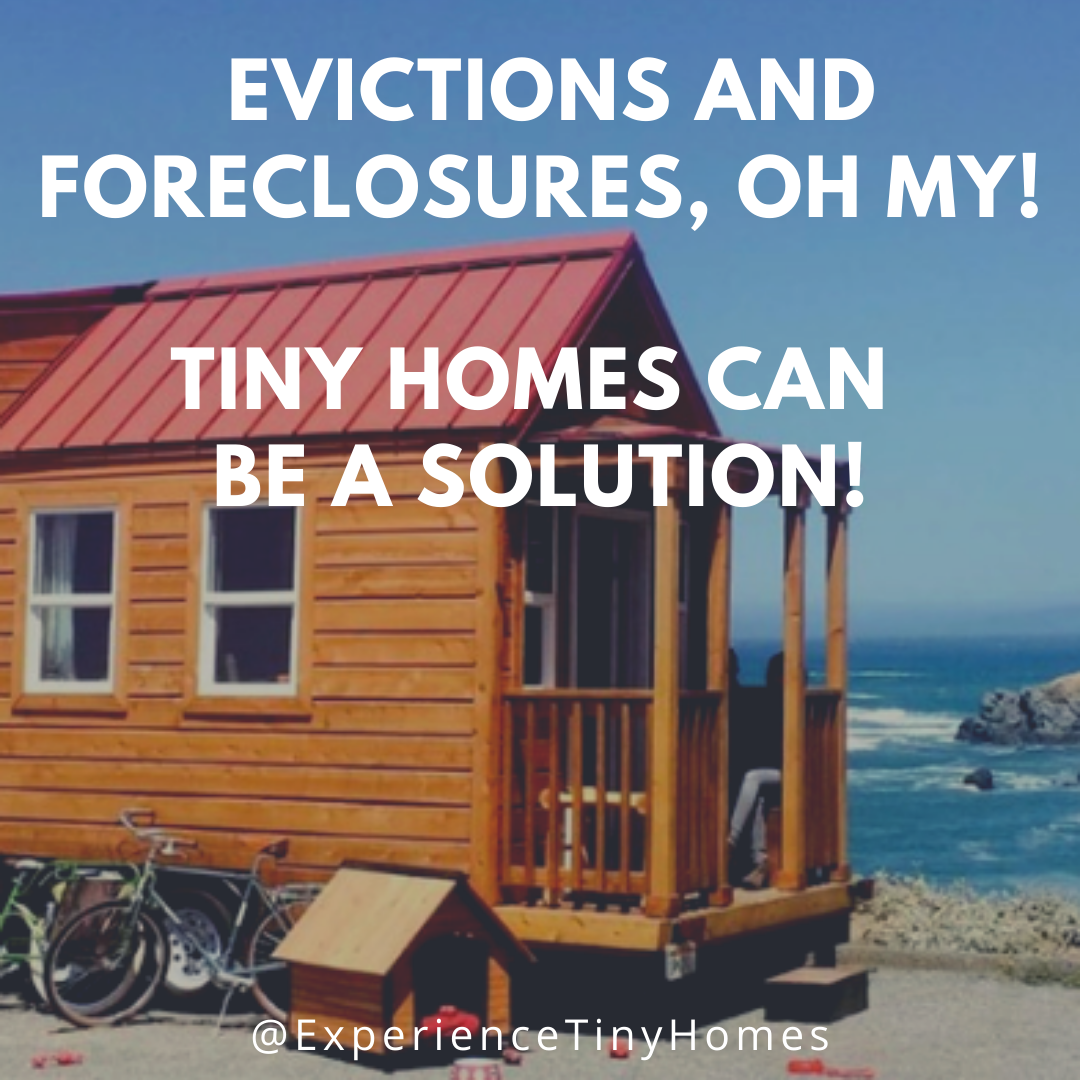
It's July 6th one day after rent is finally due. With so many across the US facing potential evictions or foreclosures this is a perfect time to share how Tiny Homes can be a terrific solution for this crisis. Before Covid-19 Tiny Homes were gaining in popularity due to the existing housing crisis resulting in housing prices being upwards of 6x the average income. (Note housing prices in the 70's were about 2x the income) Now with so much disruption from Covid-19, housing instability is even more of a concern and a reality for many. This housing eviction or foreclosure affects those who are renters but also homeowners where the banks typically "own" the home and require the mortgage to be paid. So how can Tiny Homes help both? The more cities and counties that approve Tiny Homes to be located in backyards where there is space for a Tiny Home, the more this gives both the homeowner the opportunity to earn additional income as well as a Tiny Home owner the opportunity for home ownership and lowered rent. For example, let's take my friend Kristen in San Jose area. She currently lives in San Jose and her rent is $2,800 a month for a 980 sq ft apartment. She is not in love with her apartment as it's very dark and must turn lights on even during the day. She is also grown tired of her own clutter and wants to downsize and let go of stuff. She wants to downsize and move into a 350-400 sq ft customized Tiny Home on wheels and her budget is $100,000. For the sake of this example let's assume her credit is not that great so her interest rate is 16% and she will pay that off in 10 years ( I know that sounds like a high interest and a low payback term, but stay with me). This monthly fee ends up being $1,675. As of May 2020, the nearby City of San Jose and County of Santa Clara just approved "Tiny Homes on Wheels" as Accessory Dwelling Units (ADUs is the legal term many use to talk about Tiny Homes built on foundation in the backyard of a single family home. ADUs are often referred to as In-laws, granny units, laneway houses, etc.). A typical ADU built on foundation ranges anywhere from $300k-$700k in the San Jose area, is built to the state of CA building code, and takes about 12-16 months to get completed. Note: the price for a foundation built ADU is about 3 to 7 times higher in cost than a Tiny Home on Wheels and takes 2-3x the time to be completed. Let's now say that Kristen finds a homeowner in the City of San Jose or the County of Santa Clara who has space in their backyard for a Tiny Home on wheels and who would like receive rent to help pay for the mortgage, send their kid to college, save up for retirement, etc. etc. After applying for the permit, creating the plans, expanding the underground water, sewer and electricity lines to run out to the Tiny Home the landlord determines land rent will be $1,000. (This land fee is largely determined by the local rents. For example, in Sonoma County that may reach as high as $800 but meanwhile many RV parks are charging $800-$1500-$2000 per space in populated areas). So let's sum this up... Tiny Home loan $1,675 Land fee per month $1,000 Total per month $2,675 Based on her previous rent amount she gets to pocket $125 a month. That may not seem like much savings but the major differences are...
Now, if Kirsten had great credit the loan term could be more like 15 or 20 years. Or let's say her future land fee is only $800 a month, then the numbers would look even better. I always like to play the conservative game when I run numbers so that way you can start with reality vs. fantasy. So what is the alternative to this plan? Continue paying rent for the next 10 years which will result in Kristen paying a total of $336,000 (assuming the rent does not go up which is unrealistic, even in rent controlled areas rent still goes up and up.) At the end of those ten years, Kristen will be nowhere closer to home ownership. Unless moving to another area of the state or country or moving in with family is an option, the only way to change this direction of her life is a Tiny Home On Wheels. Ok so now let's say Kristen has $50,000 to put towards her Tiny Home and does not need the entire $100k. This makes her numbers even better... Tiny Home loan $868 Land fee per month $1,000 Total per month $1,868 Now Kristen gets to choose whether or not she'll take the difference of what she was paying in rent to pay down her loan faster or put money away into savings, pay off higher interest debt, go on a vacation, send a kid to college, etc. etc. The key here is she has even more options. For homeowners facing potential foreclosure what can Tiny Homes offer? For homeowners who have enough space in their backyard, they can place a Tiny Home in their backyard and begin to collect rent from a Tiny Home owner. Getting anywhere from $500 to $1000 could be a game changer for a homeowner struggling to pay the mortgage. Additionally homeowners can provide multi-generational housing and bring family members onto the property providing a way for the entire family to support one another. So what's the catch? It all sounds so easy? Beyond the cities of Fresno, Los Angeles, San Luis Obispo, San Jose, and Santa Clara County there are many cities and counties who are still not allowing Tiny Homes on Wheels or Movable Tiny Houses...but that is changing and the more people learning how to advocate for this kind of change the more we all benefit. The type of changes that will allow more Tiny Homes to populate our US soil include:
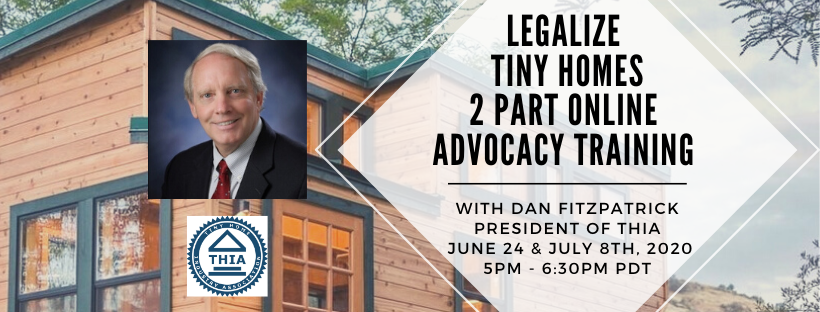
If you are eager to see your community, city, county or state legalize Tiny Homes as an ADU, or planned urban development, cluster cottage housing or a Tiny Home Village the best place to start is the... Legalize Tiny Homes 2 Part Advocacy Training Wednesday July 8th 5-6:30pm Pacific Attendance $25 By joining on July 8th you will be part of a live Q&A with Dan Fitzpatrick, Lindsay Wood and Alexis Stephens with the Tiny Home Industry Association. As a bonus you'll get a 1 year individual membership to the Tiny Home Industry Association which is working on behalf of its members to make Tiny Homes permissible as permanent housing all over US and Canada. Your membership will give you access to quarterly trainings, seminars or Q&A sessions. To sign up for the Legalize Tiny Home 2 part advocacy training please click on the orange button below. |
AuthorThe Tiny Home Lady® on a mission to co-create 100,000 Homes across the US! Archives
January 2026
Categories |

RSS Feed